A CT scan technician runs the computed-tomography (CT) scanner and produces the detailed, cross-sectional images doctors rely on to diagnose injury, stroke, cancer and internal bleeding. It is one of the core skills in radiology and medical imaging — the same family as X-ray, MRI and ultrasound — and it is a career a 12th-Science student in Bihar can enter directly, without NEET and without years of study. This guide covers what the job is, who can apply, how long the course takes, what you can earn, and where the work is.
Key takeaways
- A CT scan technician role is a specialisation within radiology and medical imaging.
- You can enter after 12th Science — no NEET, direct admission at VIMS.
- Freshers earn about ₹15,000–25,000 a month to start; the biggest pay lever is learning CT and MRI together.
What does a CT scan technician do?
A CT scan technician operates the CT scanner, positions the patient correctly, follows the imaging protocol the radiologist has set, keeps the patient safe during the scan, assists with contrast injections when needed, and passes clean images to the radiologist who reads them. In Indian hospitals and diagnostic centres the role usually spans more than one machine — technicians often operate CT, X-ray and MRI equipment, position patients safely, maintain the equipment and follow radiation-safety guidelines. CT is especially important in emergency and trauma care, where a fast scan can be the difference in the first critical hour.
Ready to build your healthcare career at VIMS?
Talk to our admissions team — direct admission, no entrance exam.
That is why CT is best understood as a specialisation within radiology and imaging technology, not a standalone trade — the patient-care, imaging-safety and scan-quality skills carry across every machine in the department.
How does a CT scanner actually work?
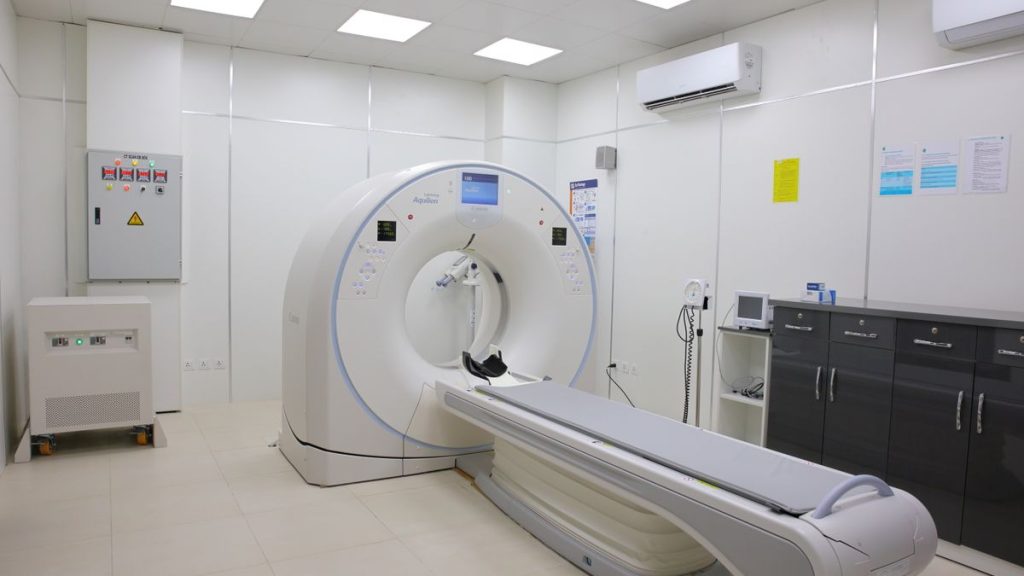
A CT scanner is essentially a fast, computerised X-ray machine. Inside the ring-shaped part of the scanner (the gantry), an X-ray tube rotates around you while you lie on a bed that moves slowly through the ring. As the tube spins, detectors on the opposite side capture the X-rays that pass through your body, and a computer turns those readings into thin cross-sectional “slices” — like looking at one slice of a loaf of bread rather than the whole loaf at once (NIH National Institute of Biomedical Imaging and Bioengineering). Stacking the slices builds a detailed 3D picture that shows bone and soft tissue far more clearly than an ordinary X-ray (Cleveland Clinic).
Because CT uses X-rays, it involves a small amount of radiation — and managing that safely is a real part of the job. Technicians are trained to keep every dose as low as reasonably achievable (the ALARA principle): scanning only the area needed, adjusting the dose to the patient’s size, and using well-maintained equipment. In India, radiation safety in imaging is regulated by the Atomic Energy Regulatory Board (AERB), and hospitals value technicians who have been properly trained in radiation protection.
CT vs MRI vs X-ray vs ultrasound — where CT fits
All four sit under radiology, but they work differently, and a good imaging technician understands all of them:
- X-ray — uses radiation; fast and cheap; the first look at bones and chest.
- CT scan — combines many X-rays into cross-sections; uses radiation; fast; excellent for trauma, stroke and internal injuries.
- MRI — uses a magnet and radio waves, no radiation; the best soft-tissue detail; slower and more expensive.
- Ultrasound — uses sound waves; real-time and radiation-free; used in pregnancy and abdominal scans.
CT is the one hospitals reach for in an emergency, because it is fast and shows internal injuries clearly.
Who can apply — eligibility
You can join after passing 12th with Science (Physics, Chemistry and Biology, or with Mathematics). Admission at VIMS is direct — there is no entrance exam, and NEET is not required for a radiology and imaging technology course; NEET applies only to the MBBS/MD doctor route. A diploma-holder in a related field can also join through the lateral route. Bring your 10th and 12th marksheets and the standard admission documents, and the admissions team confirms eligibility within a few working days.
How long is the course?
CT is taught within radiology and imaging technology, and there are two routes:
- Degree route — 3 years, followed by a supervised hospital internship. Preferred by large hospitals and diagnostic chains.
- Diploma route — 2 years. The fastest way into paid work.
Both are taught at the VIMS campus in Patna with clinical postings built in, so you train on real equipment rather than only in a classroom.
What you will learn
- How a CT scanner works — the practical physics of computed tomography
- Cross-sectional anatomy — reading the body slice by slice
- Patient positioning, contrast media and scan protocols
- Radiation safety and protection, and emergency response during scans
- Working inside a radiology department and using hospital PACS/RIS imaging systems
- Cross-training across X-ray, MRI and ultrasound, so you understand the full imaging workflow
CT scan technician salary in India
Pay depends heavily on where you work and how many machines you can run. Reported figures vary between salary sites, so here is an honest picture, not a promise:
- Fresher, private hospital: roughly ₹15,000–25,000 a month to start.
- With experience / multi-modality skills: rises steadily — running CT and MRI is the single biggest pay lever, because one technician who covers both is far more valuable to a hospital.
- Government posts: the most stable, on the 7th Pay Commission scale for radiographer roles, and generally above private entry pay.
- Overseas (Gulf, UK): trained radiographers are actively recruited abroad, at much higher pay, once you have experience and the required registration.
These are general industry references, not a placement guarantee, and salary sites disagree — treat them as ranges, not fixed numbers.
Is there demand for CT scan technicians?
Yes, and it is structural. India’s diagnostic-imaging market is growing at roughly 7–8% a year, yet the country has only about one radiologist per 100,000 people, and trained imaging staff are in short supply — the shortage is worst outside the big metros. Diagnostic chains are expanding into tier-2 and tier-3 cities across Bihar, and the Union Budget 2026-27 funds close to one lakh new allied-and-healthcare professionals over five years, radiology among them.
The gap is real and local: in August 2026, a leading Patna government hospital reported that advanced CT and MRI machines sat ready for weeks but could not be switched on for want of trained technicians — and planned to recruit around 30 technical staff to run them across shifts. That is demand for exactly this skill, in this city.
Why train at VIMS, Patna
VIMS is a private paramedical and physiotherapy college on Agamkuan Main Road, Patna. Every programme ends with a supervised hospital internship, and the placement cell connects students with hospitals and diagnostic centres across Patna and Bihar. Fees are paid semester by semester, with every charge listed up front. CT is taught as part of the college’s radiology and imaging technology programme.
Ready to start your CT and imaging career? Direct admission on your 12th Science marks — no entrance exam.
Frequently asked questions
Can I do a CT scan technician course after 12th?
Yes. After 12th with Science you can join directly, with no entrance exam and no NEET.
How long is the CT scan / medical imaging course?
The degree route is 3 years plus internship; the diploma route is 2 years.
Is CT scan a diploma or a degree course?
VIMS offers both — a 3-year degree and a 2-year diploma in radiology and imaging technology, conferred by a UGC-recognised university. CT is a specialisation taught within it.
What is the CT scan technician course fee?
Fees are charged semester by semester. You can see the current fee structure on the admission page or by calling the toll-free number.
Do I need NEET to become a CT scan technician?
No. NEET is only for MBBS/MD. A radiology and imaging technology course needs 12th Science.
What does a CT scan technician earn in India?
Freshers typically start around ₹15,000–25,000 a month in private hospitals, rising with experience and multi-modality (CT + MRI) skills; government and overseas roles pay more. Figures are general references, not guarantees.
Is CT technician the same as radiology?
CT is one part of radiology and imaging technology, alongside X-ray, MRI and ultrasound. A CT technician is a radiology and imaging professional who specialises in CT.
Where do CT scan technicians work?
In hospital radiology departments, diagnostic and imaging centres, and super-speciality and trauma hospitals — where CT is critical for emergencies.
Start my application at VIMS
Choose how you would like to begin. UGC-recognised programs, hospital-based training in Patna.