An MRI technician runs magnetic resonance imaging scanners and produces the detailed images doctors depend on to diagnose injury and disease. It is one of the core roles in radiology and medical imaging — the same family as X-ray, CT and ultrasound — and it is a career a 12th-Science student in Bihar can enter directly, without NEET and without years of study. This guide covers what the job is, who can apply, how long the course takes, what you will earn, and where the work is.
Key takeaways
- An MRI technician role is a specialisation within radiology and medical imaging.
- You can enter after 12th Science — no NEET required.
- Freshers earn about ₹1.8–3 LPA, rising to ₹4–7 LPA with experience.
What does an MRI technician do?
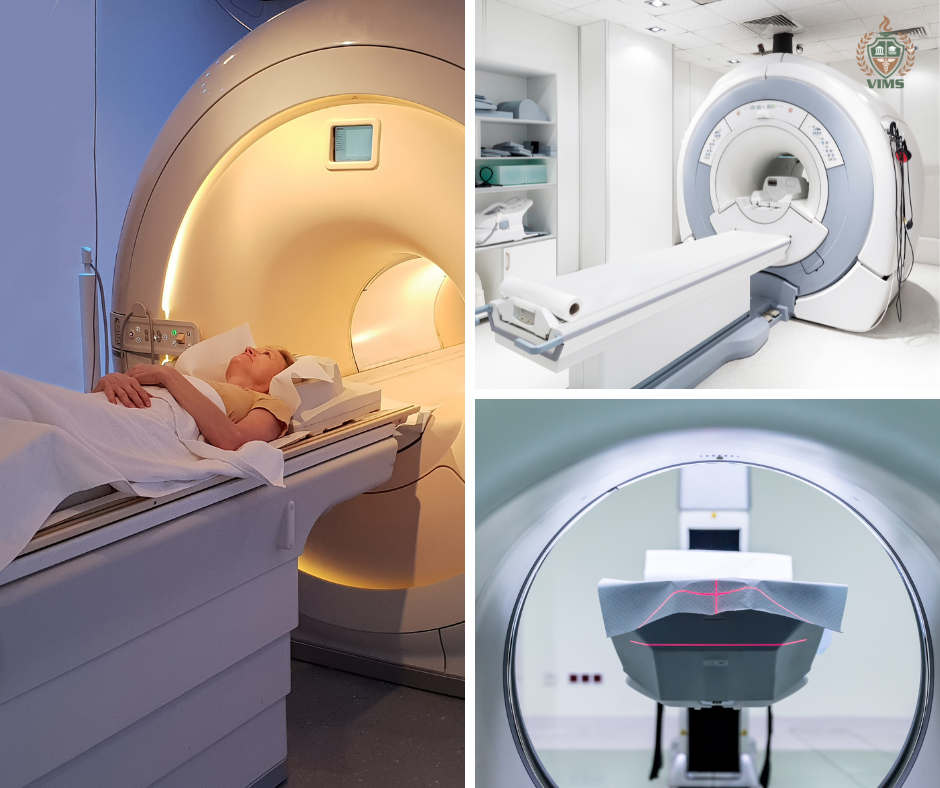
An MRI technician (also called an MRI technologist or radiographer) operates the MRI scanner, positions patients correctly, screens them for metal objects before the powerful magnet is switched on, and produces the images a radiologist reads. In Indian hospitals the role usually spans more than one machine — job listings from large hospitals and diagnostic chains describe technicians who operate CT, MRI and X-ray equipment, ensure patient positioning and safety, maintain equipment and follow NABH and AERB radiology-safety guidelines (Indeed India, Glassdoor India, 2025–26). That is why MRI is best understood as a specialisation within radiology and imaging technology, not a standalone trade — the patient care, imaging safety and scan-quality skills carry across every modality.
Ready to build your healthcare career at VIMS?
Talk to our admissions team — direct admission, no entrance exam.
Who can apply — eligibility
You can join after passing 12th with Science (Physics, Chemistry and Biology, or with Mathematics). Admission at VIMS is direct — there is no entrance exam, and NEET is not required for a radiology and imaging technology course; NEET applies only to MBBS/MD routes. A diploma-holder in a related field can also join through the lateral route. Bring your 10th and 12th marksheets and the standard admission documents, and the admissions team confirms eligibility within a few working days.
How long is the course?
There are two routes, and MRI is taught within both as part of the wider imaging syllabus:
- Degree route — 3 years, followed by a supervised hospital internship. Preferred by large hospitals and diagnostic chains.
- Diploma route — 2 years. The fastest way into paid work.
Both are taught at the VIMS campus in Patna with clinical postings built in, so you train on real equipment rather than only in a classroom.
What you will learn
- How an MRI scanner works — the physics of magnetic resonance imaging, in practical terms
- Patient positioning, safety screening and imaging protocols
- MRI and radiation safety, contrast handling and emergency response
- Working inside a radiology department and using hospital PACS/RIS imaging systems
- Cross-training across X-ray, CT and ultrasound, so you understand the full medical-imaging workflow
How does an MRI machine actually work?
Your body is mostly water, which is full of hydrogen atoms, and each hydrogen nucleus behaves like a tiny magnet. Inside the scanner’s strong magnetic field these line up; the machine then sends a radio-wave pulse tuned to their natural frequency — the “resonance” in Magnetic Resonance Imaging — which knocks them out of alignment. When the pulse stops, they relax back and emit faint radio signals that receiver coils pick up, and a computer turns those signals into detailed cross-sectional images (NIST; Cleveland Clinic). Because different tissues relax at different rates, MRI shows soft tissue — brain, spine, ligaments — in exceptional detail. Clinical scanners are usually 1.5 or 3 Tesla; for scale, the Earth’s own magnetic field is only about 0.5 Gauss and 1 Tesla equals 10,000 Gauss (University of Utah School of Medicine).
MRI vs CT vs X-ray vs ultrasound — where MRI fits
All four sit under radiology, but they work differently, and a good imaging technician understands all of them (Iowa Radiology; Cleveland Clinic):
- X-ray — uses radiation; fast and cheap; best first look at bones and chest.
- CT scan — combines many X-rays into cross-sections; uses radiation; excellent for trauma and emergencies.
- MRI — uses a magnet and radio waves, no radiation; the best soft-tissue detail; slower and more expensive.
- Ultrasound — uses sound waves; real-time, portable, radiation-free; used in pregnancy and abdominal scans.
MRI technician salary in India
Pay depends heavily on where you work and how many machines you can run. Reported figures vary between salary sites, so here is an honest range with sources:
- Fresher, private hospital: roughly ₹15,000–25,000 a month (about ₹1.8–3 lakh a year) to start (industry data, 2026; PayScale India).
- With experience / multi-modality skills: around ₹4–7 lakh a year — running CT and MRI is the single biggest pay lever.
- Government posts: the most stable, at 7th Pay Commission Level 7 (basic ₹25,500–₹81,100 a month) for radiographer roles (Testbook).
- Overseas (Gulf): radiographers earn roughly US$2,000–5,500 a month, tax-free, with CT/MRI specialists at the higher end (Neelim Healthcare Consulting, 2026).
These are general industry references, not a placement guarantee, and salary sites disagree — treat them as ranges, not fixed numbers.
Is there demand for MRI technicians?
Yes, and it is structural. India’s medical-imaging market is growing at roughly 7–8% a year (Grand View Research; IMARC Group), yet the country has only about 1.5–2 MRI machines per million people, against 10–30 in developed countries (Inter-University Accelerator Centre). Diagnostic chains are expanding into tier-2 and tier-3 cities, and the Union Budget 2026-27 funds around 1 lakh new allied and healthcare professionals over five years, radiology among them (Business Standard). Abroad, chronic imaging-staff shortages in the UK NHS and the Gulf keep pulling trained Indian technicians overseas.
Why train at VIMS, Patna
VIMS is a paramedical and physiotherapy college on Agamkuan Main Road, Patna. Every programme ends with a supervised hospital internship, and the placement cell connects students with hospitals and diagnostic centres across Patna and Bihar. Fees are paid semester by semester, with every charge listed up front. MRI is taught as part of the college’s radiology and imaging technology programme — see the full course below.
Ready to start your MRI and imaging career? Direct admission on your 12th Science marks — no entrance exam.
Frequently asked questions
Can I do an MRI technician course after 12th?
Yes. After 12th with Science you can join directly, with no entrance exam and no NEET.
How long is the MRI / medical imaging course?
The degree route is 3 years plus internship; the diploma route is 2 years.
Is MRI a diploma or a degree course?
VIMS offers both — a 3-year degree and a 2-year diploma in radiology and imaging technology, conferred by a UGC-recognised university. MRI is a specialisation taught within it.
What is the MRI technician course fee?
Fees are charged semester by semester. You can see the current fee structure on the admission page or by calling the toll-free number.
What does an MRI technician earn in India?
Freshers typically start around ₹1.8–3 lakh a year in private hospitals, rising to ₹4–7 lakh with experience and multi-modality skills; government and overseas roles pay more. Figures are general references, not guarantees.
Do I need NEET to become an MRI technician?
No. NEET is only for MBBS/MD. A radiology and imaging technology course needs 12th Science.
Where do MRI technicians work?
In hospital radiology departments, diagnostic and imaging centres, and super-speciality hospitals — in India and abroad.
Start my application at VIMS
Choose how you would like to begin. UGC-recognised programs, hospital-based training in Patna.